How to spot an AI scam
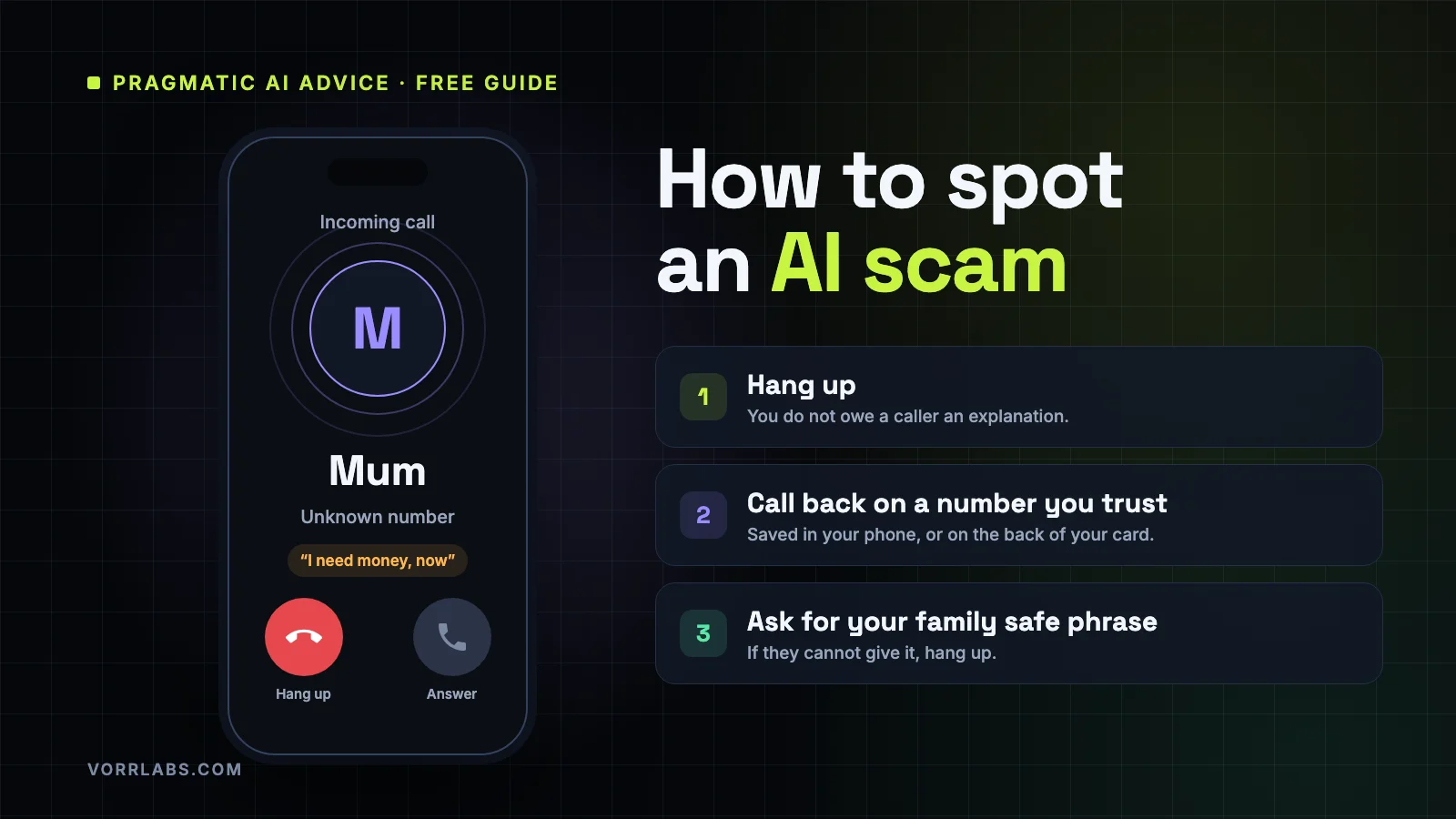
Fraudsters can now use AI to copy a real person's voice, and the defence is the same as it has always been: hang up, and check.
This is the first of our free one-page guides. It is for anyone who gets phone calls, texts or messages and wants to know when AI is being used against them. You do not need to understand the technology to use it.
What is happening
HM Government's Stop! Think Fraud campaign says fraudsters may use AI to create deepfakes: fake audio, images or video that take on the exact likeness of a real person. The person imitated can be a celebrity, someone you know, or you.
On the phone, that means a call can sound like your son, your granddaughter or your bank. The number on your screen can be faked too. The story is usually urgent: an accident, a lost phone, a frozen account, money that has to move now.
The technology is new. The trick is old: make you act before you check.
What to look for
Any one of these is a warning sign.
- An urgent story, and pressure to act straight away.
- A request for money, a bank transfer, a one-time passcode (the code your bank texts you), a PIN or a password.
- A request to let someone take control of your computer.
- A familiar voice from an unfamiliar number, or one that cannot answer a question only they would know.
- A caller who tries to rush you, or will not let you call them back.
What to do
- Hang up. You do not owe a caller an explanation.
- Call back on a number you already trust: the one saved in your phone, on a bill, or on the back of your bank card. To reach your bank, dial 159.
- Agree a safe phrase with close family and friends, and keep it inside that circle. If a caller claiming to be family cannot give it, hang up.
- Your bank, the police and your phone or internet provider will never call to ask you to move money, share a passcode or hand over control of your computer.
- If you have already paid or shared details, do not panic. Call your bank straight away on the number on your card, then report it.
Where to get help
- To report fraud in England, Wales or Northern Ireland: Report Fraud at reportfraud.police.uk, or 0300 123 2040. In Scotland, call Police Scotland on 101.
- Scam text: forward it to 7726, free. Scam call: text 7726 with the word "Call" followed by the number.
- Scam email: forward it to report@phishing.gov.uk.
- Support after fraud: Victim Support on 08 08 16 89 111 (England and Wales, free, 24 hours), or 0800 160 1985 in Scotland (Monday to Friday, 8am to 8pm). In Northern Ireland, Victim Support NI, Belfast 02890 243133 or Foyle 02871 370086.
- In immediate danger: 999.
The printable version
The one-page PDF is free to download, print and pass on. Download the one-page guide (PDF)
Want to go through this with other people?
We run a two-hour beginner group session, in person across the North East and online, on what AI is, what it is not, and how to stay safe. Plain English, gentle pace, no question too small.
Details and prices are at vorrlabs.com/aihelp/. Or email vincent@vorrlabs.com.
Sources (checked 10 October 2026)
- Stop! Think Fraud, HM Government: Recognise the tactics, How to spot phone fraud, Reporting fraud, Get support after fraud
- Report Fraud, the national reporting centre for fraud and cyber crime